
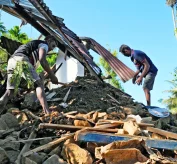

Rebuilding Housing Post-Ditwah: Lessons from Sri Lanka’s Tsunami Experience
The recent Cyclone Ditwah damaged over 80,000 houses in Sri Lanka, ranking second only to the December 2004 Tsunami. The government has announced a redevelopment programme to assist affected families in rebuilding their homes in safer locations. It has many similarities to the 2005 post-Tsunami housing programme and holds important insights as outlined in the Post-Disaster Housing: Lessons Learnt from the 2004 Tsunami of Sri Lanka, to inform the Ditwah Cyclone housing initiative.

Prioritising Child-Friendly Policies: Addressing Sri Lanka’s Child Malnutrition Crisis
Even before the onset of COVID-19, malnutrition stood as a significant driver of multi-dimensional poverty among children in Sri Lanka. Startling data from the Department of Census and Statistics (DCS) in 2019 revealed that one in three children aged 0 to 4 who are multidimensionally poor, are either underweight or stunted. The multiple crises that affected Sri Lanka since 2020 have only exacerbated the already precarious nutrition situation in poor households. This blog argues the need for prioritising social policies focused on children to ensure sustained investment in human capital.

Why Promoting Decent Work Matters More Than Just Any Job for Sri Lankan Women
Sri Lanka’s low female labour force participation rate (FLFP) has received intense policy attention over the past several decades for many reasons. It is widely assumed that improving FLFP will not only empower women and reduce gender disparities but will also promote productivity and economic growth. Over the years, a popular strategy for promoting FLFP by successive governments has been to encourage self-employment opportunities or entrepreneurship. However, FLFP has remained below 35% for years. Self-employment jobs are highly vulnerable to economic fluctuations as social safety nets do not cover them. Furthermore, on average, self-employment income is lower than other types of income. This blog argues that to empower women and drive economic growth, policy should focus on facilitating women’s access to decent work over access to any job.

Sri Lanka’s Labour Market Amidst COVID-19: The Need for Targetted Interventions
Lockdowns and restricted mobility have devastated labour markets across the world. According to the International Labour Organization (ILO), the equivalent of 225 million jobs was wiped out globally due to employment and working hour losses in 2020 compared to 2019 (Q4). These working hour losses are four times higher than those experienced during the global financial crisis in 2009. The COVID-19-instigated recession has affected the quantity and the quality of jobs, with increasing levels of informal types of work with lower remuneration. Restoration of labour markets is important to minimise damage to human development and increase aggregate demand, thereby boosting economic recovery. This blog looks at why it is important to have targetted policy interventions to revive the labour market by illustrating that the impact of COVID-19 is different across occupations and industries.

Weathering Disasters: Why it Pays to be Prepared
Disasters such as COVID-19 can significantly impede development. While it is difficult to avoid being affected by disasters, disaster preparedness can reduce the costs, and quicken the recovery.
Demystifying Hawala/Undiyal – The Not So Dismal Science:[…] believed that informal fund transfer operations in Sri Lanka have expanded considerably due to the wide gap between the…