

EUDR in 2025: Is Sri Lanka Ready for the EU’s New Deforestation Rules?
Sri Lanka faces a critical test with the EU’s Deforestation Regulation (EUDR) taking effect in December 2025. With rubber exports to the EU valued at over USD 330 million annually, compliance is vital. While large plantations may adapt easily, smallholder farmers who manage over two-thirds of rubber cultivation face digital and documentation challenges. Without targeted support, Sri Lanka risks losing market access, jobs, and GDP. This blog explores readiness, risks, and policy priorities for EUDR compliance.

Occupational Exposure to GenAI in Sri Lanka
The first two infographics in this blog were created with Artificial Intelligence (AI) technology, resulting in production times of mere seconds. In contrast, creating similar infographics without AI would typically require several hours of work. This illustrates how AI significantly boosts worker productivity. Nearly every sector showcases examples of AI enhancing labour efficiency. For instance, online educational content can be effortlessly generated with AI by just inputting text.
Beyond the Numbers: The Real Costs and Benefits of Migration for Migrant Mothers
The female migration pattern in Sri Lanka has fluctuated notably over recent years. In 2018, considered a normal year before the economic crisis, women made up 38.6% (81,499) of total departures for foreign employment. However, in 2023, during the peak of Sri Lanka’s economic crisis, their share increased to 44.7% (133,048).
Although women made up less than half of all migrant departures (44.7%) in 2023, they accounted for 80.3% of the total complaints (6,051 out of 7,535) received by the Sri Lanka Bureau of Foreign Employment (SLBFE), indicating that complaints are proportionally higher among female migrants. Among these, wage-related grievances stand out. Of particular concern is that in 2023 alone, the SLBFE documented 694 complaints about wage non-payment, over half of which were lodged by FMWs. But behind the statistics, personal struggles often go unnoticed, and these untold stories deserve to be heard.
Empowering Sri Lankan Women: Highlights from the National Policy Conference on Women’s Access to Decent Work in Sri Lanka
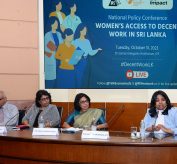
The Institute of Policy Studies of Sri Lanka (IPS) recently conducted a thought-provoking discussion aimed at improving women’s access to decent work in Sri Lanka. The event, titled the ‘National Policy Conference on Women’s Access to Decent Work,’ was organised in collaboration with the Partnership for Economic Policy (PEP) and Co-Impact and took place at the Dr Saman Kelegama Auditorium, IPS.

Why Promoting Decent Work Matters More Than Just Any Job for Sri Lankan Women
Sri Lanka’s low female labour force participation rate (FLFP) has received intense policy attention over the past several decades for many reasons. It is widely assumed that improving FLFP will not only empower women and reduce gender disparities but will also promote productivity and economic growth. Over the years, a popular strategy for promoting FLFP by successive governments has been to encourage self-employment opportunities or entrepreneurship. However, FLFP has remained below 35% for years. Self-employment jobs are highly vulnerable to economic fluctuations as social safety nets do not cover them. Furthermore, on average, self-employment income is lower than other types of income. This blog argues that to empower women and drive economic growth, policy should focus on facilitating women’s access to decent work over access to any job.
Demystifying Hawala/Undiyal – The Not So Dismal Science:[…] believed that informal fund transfer operations in Sri Lanka have expanded considerably due to the wide gap between the…