

- Home
- Microinsurance in Sri Lanka: Combating Multiple and Overlapping Vulnerabilities
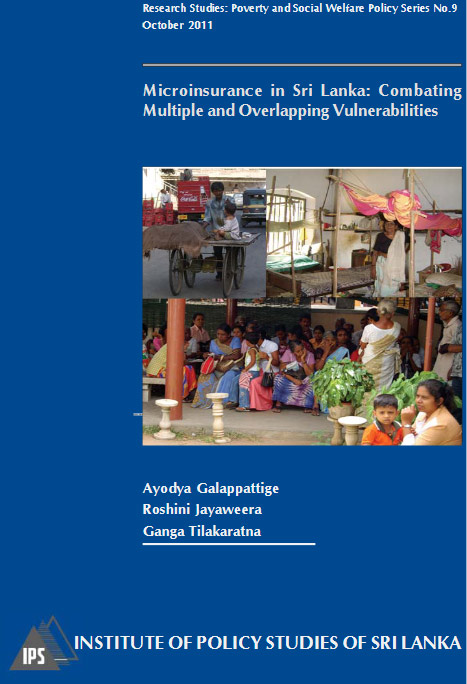
Series : Poverty and Social Welfare Policy
While the provision of financial services (credit and savings) to the poor through microfinance is an established concept, the provision of insurance to the poor through microinsurance is relatively new. As a result, most microinsurance providers are affiliated to microfinance institutes while specialized providers are fewer in number. This study fills the gap in literature currently available on microinsurance, by providing a critical insight through the examination of the behavior and needs of segments of the microinsurance market in Sri Lanka. This, establishes the basis for the design and development of demand driven, risk managing financial products.
This study looks at the differences of the products, delivery methods and the extent to which they reflect the needs and preferences of the poor households. It used both qualitative and quantitative research methods through desk reviews, key informant interviews, and a household survey of 330 households in 2008.
The results showed that that many households use insurance or borrowed from the informal sources in managing risks. The households in microinsurance prefer life insurance over the other types of insurance. The households find the microinsurance premiums are designed in a comfortable way for payment. The products offered by the microinsurance providers are limited to cover a very few types of risks the poor households frequently face. The providers use the existing strengths of the institutes to reach the clients at a lower cost at the door-step of the client. However, the microinsurance providers have the opportunity to improve the services at relatively higher premiums. The study further illustrated that due to the lack of a regulatory framework, some private companies are unwilling to engage in microinsurance. This also has forced the current providers to depend more on limited donor support and/or premiums collected from members instead of reinsurance. The lack of skilled manpower was also identified as a serious setback in the expansion of the sector, as well as the lack of funding to support the expansion of services.
Table of Contents


Publication
Available for sale at IPS and leading bookshops island-wide.
Contact
Mob: +94776099898
Tel: +94-11-2143 100 / +94-11-2665068
Email: [email protected]
Price
US$ 15 (for hardcopy)
ISBN
978-955-8708-69-9
Published Year
October 2011
