

- Home
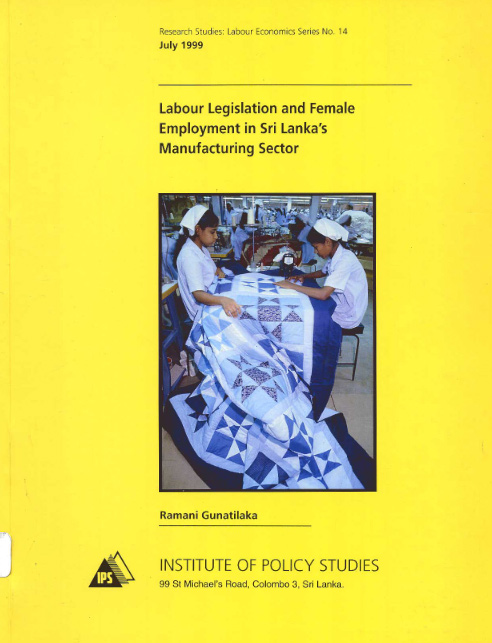
- Labour Legislation and Female Employment in Sri Lanka’s Manufacturing Sector
Series: Labour Economics
Economic policy liberalisation in Sri Lanka has been associated with rising female labour force participation in the manufacturing sector, as in many developing countries. Coupled with the other economic changes that have been taking place, the feminisation of Sri Lanka’s manufacturing industry has profound implications for existing labour legislation. This study reviews the existing legislation to assess the extent to which it is meeting its original objectives of ensuring social justice, and whether regulations designed to protect women workers have led to even more discrimination against them. The study shows that increasing female employment in Sri Lanka has been associated with low wages, poor working conditions, and significant erosion of labour standards. Minimum wage legislation has been implicitly weakened, regulations on working hours and night work openly flouted, and laws protecting the health and safety of workers ignored for the most part, particularly in the smaller, non-unionised establishments producing for the domestic market.
Key policy recommendations include the following: maintaining a macroeconomic and sectoral policy framework to encourage high-tech, knowledge-based industries; implementing skills training programmes that cater to such industries; legislative reform; strengthening mechanisms for monitoring and enforcing labour standards; and, measures to develop human resources management skills.
Table of Contents
by Ramani Gunatilaka

Publication
Available for sale at IPS and leading bookshops island-wide.
Contact
Mob: +94776099898
Tel: +94-11-2143 100 / +94-11-2665068
Email: [email protected]
Price
US$ 15 (for hardcopy)
ISBN
955-9122-74-6
Published Year
July 1999
