

- Home
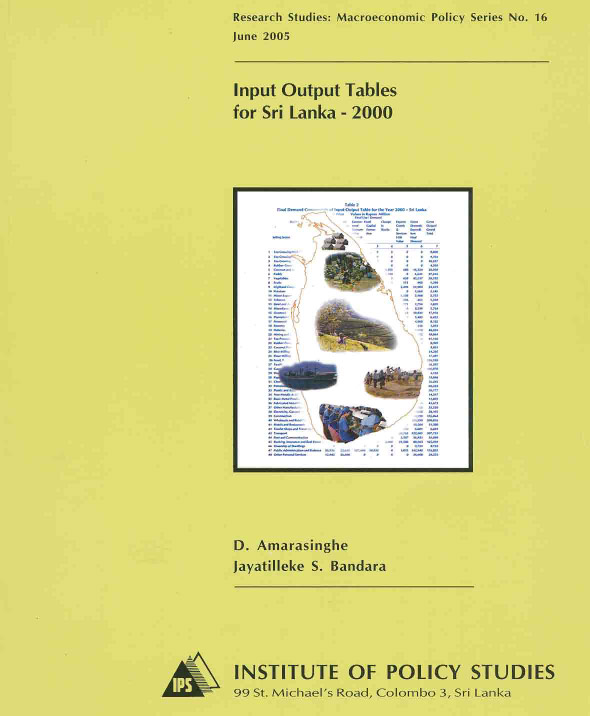
- Input Output Tables for Sri Lanka – 2000
Series: Macroeconomic Policy No. 16
This publication is a part of the IPS research programme on “Economy-Wide Modelling for Policy Analysis”, and presents a detailed Input-Output (I-O) table and other associated tables (import matrix, direct coefficient matrix, and the Leontief inverse) for Sri Lanka compiled for the year 2000. The main I-O table presents a detailed structure or the “snap-shot” of the Sri Lankan economy. After two decades, for the first time, the IPS is proud to release I-O tables for Sri Lanka with a detailed document on the procedures of compilation with an electronic version of I-O tables.
Government statistical offices and research institutions in many developed and developing countries compile I-O tables for their economies at regular intervals as a national statistical requirement and for the purpose of providing detailed databases for policy analysis as well as economy-wide modelling. Unfortunately, the compilation of I-O tables for the Sri Lankan economy has been irregular even though the history of compiling I-O tables for the Sri Lankan economy goes back to the 1960s. This has been one of the most neglected areas of research in recent years. This has also been a main constraint in developing an economy-wide model for policy analysis. To fill this research vacuum, the IPS started a new project on economy-wide modelling. Under the current project, a detailed computable general equilibrium (CGE) model of the Sri Lankan economy is being constructed. The I-O table presented here is the first and the most significant step toward developing this model for policy analysis.
The basic I-O table was compiled following the framework shown in the System of National Accounts (1993) and its concepts, definitions, and methodology of compiling I-O tables. The basic I-O table is closely related to the National Accounts. It can be used to cross check the accuracy of the National Accounts that are estimated annually. It can also be treated as a reconciliation of National Accounts.
Sri Lanka is currently preparing for the rebuilding process after facing the devastating effects of the Indian Ocean Tsunami in December 2004 and the two decades of the North/East conflict. In order to undertake policy analysis related to this process, a better understanding of the economic structure within an economy-wide framework is necessary. This table will assist policy analysts to understand the “backward and forward linkages” in the economy and undertake simple “impact analyses”. Thus, from a policy analysis viewpoint, I consider the release of these tables as timely.
The IPS provided financial support and coordinated the project. The project is an outcome of the collaboration of the IPS, the Department of Census and Statistics, and Griffith University in Australia. The collaboration will continue throughout the construction of the CGE model, which will ultimately be used by the IPS for policy analysis. It is hoped that this publication will meet the needs of planners, policy makers, and economy-wide modellers.
Saman Kelegama
Executive Director
June 2005
Table of Contents:
by D. Amarasinghe and Jayatilleke S. Bandara

Publication
Available for sale at IPS and leading bookshops island-wide.
Contact
Mob: +94776 099898
Tel: +94-11-2143 100 / +94-11-2665068
Email: [email protected]
Price
US$ 15 (for hardcopy)
ISBN
955-8708-43-X
Published Year
June 2005
