

- Home
- A Statistical Overview of Employment and Unemployment Trends
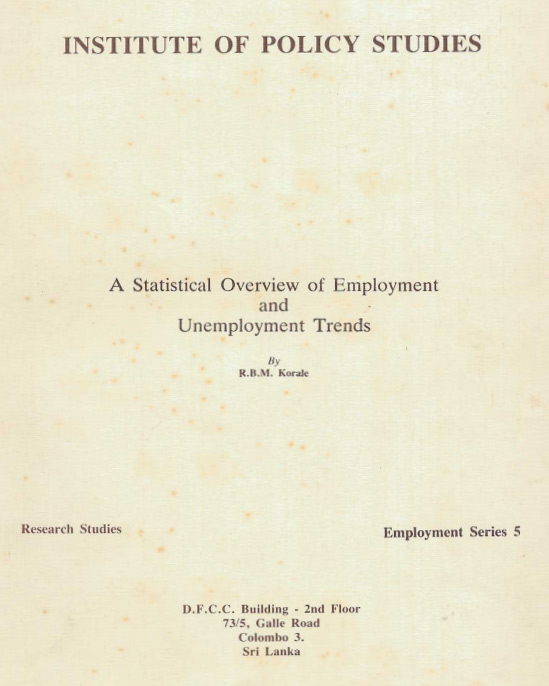
Series: Employment
Sri Lanka’s demographic and labour force variables have aroused much interest and came into focus, mainly because of the very high levels of unemployment the country has been experiencing for more than two decades. In the post-independent era it has been, except during very brief periods, a case of slow growth in demand for labour, leaving a part of the net annual additions to the work-force without productive employment and adding them to the expanding pool of surplus labour. The problem of surplus labour has become complex and intractable. In addition to open unemployment, underemployment of different types and intensities, the mismatch between expectations and opportunities and structural unemployment have aggravated the problem.
The dimensions, incidence and characteristics of the unemployed population are therefore important, and detailed information on them is of interest and value for decision making and policy review.
The problem of surplus labour in Sri Lanka has been studies from several perspectives and the objective of this paper is restricted to the provision of a statistical overview of employment and unemployment trends as they have evolved during the past three decades. The statistical data base available on employment and unemployment is neither comprehensive nor of high quality. Surveys for the measurement of the labour force have not been undertaken regularly and comparability between data sets has been lost through changes in definition and concepts. Because of these limitations, a dedicated analysis of the subject has been difficult. The study proposes to:
Identify the sources of labour force data and describe the type and nature of the information available and their volume and content.
Briefly present the problems and issues which have been encountered in the measurement of employment and unemployment in census and surveys which affected the quality of the estimates Utilise the available data in the form in which they are presented to set out and analyse the overall dimensions and trends of employment and unemployment Examine in detail the changes and shifts in employment and unemployment, including those at sectoral and subsectoral levels, specially in those components and parameters of interest for policy purposes
Noting the limitations in data quality and possible underestimation of labour force variables, trace the trends of labour force variables, reconstructing where necessary and preparing limits over time.
Table of Contents:

Publication
Available for sale at IPS and leading bookshops island-wide.
Contact
Mob: +94776099898
Tel: +94-11-2143 100 / +94-11-2665068
Email: [email protected]
Price
US$ 10 (for hardcopy)
ISBN
955-9122-14-2
Published Year
July 1992
