

- Home
- Winners and Losers of Sri Lanka’s Work from Home Policy
Series: Labour and Migration Research Series
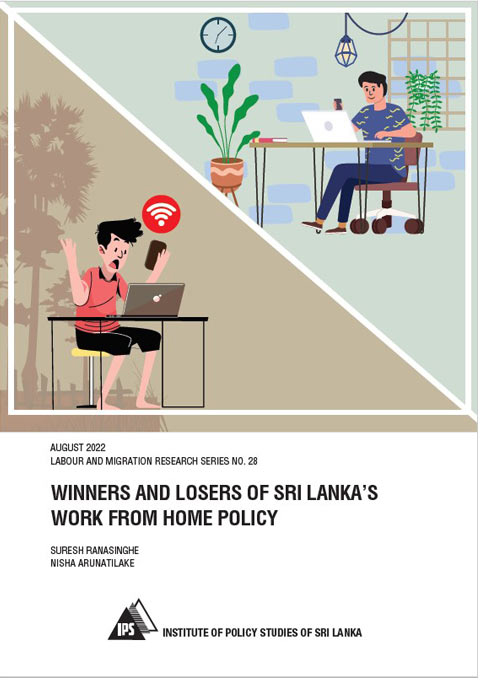
Sri Lanka’s current economic crisis and the COVID-19 pandemic has resulted in great losses of work hours and jobs due to the difficulties in transportation, lack of fuel, health regulations, and other basic necessities. Some firms have overcome these problems by allowing workers to Work from Home (WFH) or telework. However, not all workers can do this. This study identifies how the WFH policy affects the economic engagement of different workers in Sri Lanka. The study maps the plausibility of WFH probabilities compiled by Dingel and Neiman (2020), with regard to Sri Lankan data to assess the WFH probabilities of Sri Lankan workers. The results show that the potential for WFH depends on the industry and occupation of work and socio-economic factors such as age, gender, education, income and geographical location.
The study further illustrates that employees with low educational attainment and living in rural and estate areas can WFH the least. Notably, in Sri Lanka, most employees belong to occupations where the feasibility to WFH is relatively low.


Publication
Available for sale at IPS and leading bookshops island-wide.
Contact
Mob: +0776 099898
Tel: +94-11-2143 100 / +94 -11-2665065
Email: [email protected]
ISBN
978-955-7397-27-6
Published Year
August 2022
Price
LKR 1,500