- Home
- Economic Effects of US Tariffs on South Asia: Insights from a Regional Panel Discussion

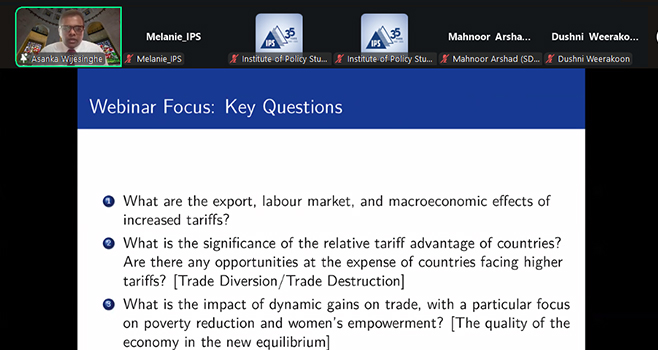
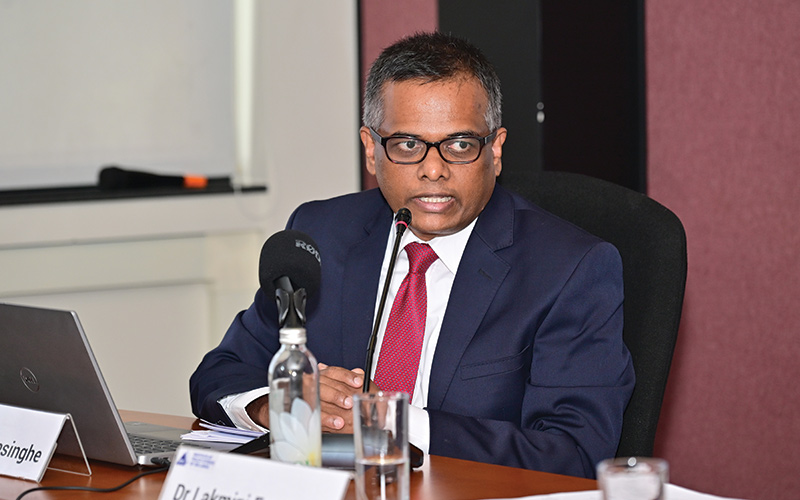
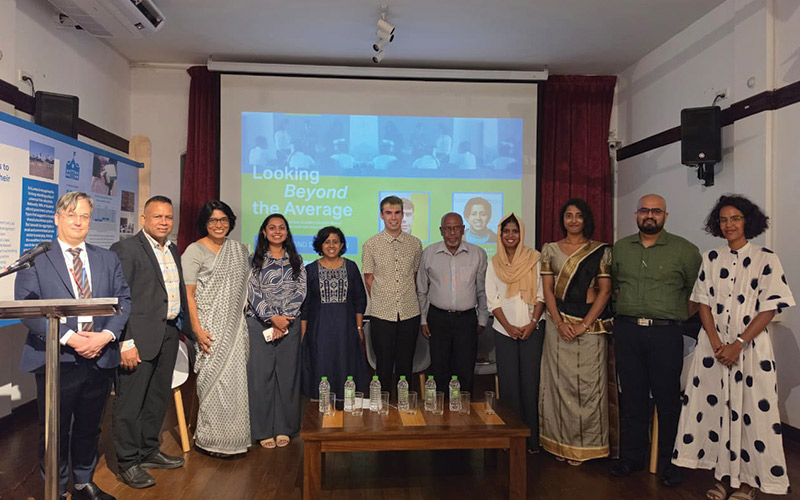
“The contraction of export-driven industries may negatively affect the long-term growth and sustainable development gains, mainly affecting women and low-skilled workers,” explained Dr Asanka Wijesinghe during a recent panel discussion organised by the Institute of Policy Studies of Sri Lanka (IPS) to discuss the economic effects of US tariffs on South Asia. Dr Wijesinghe presented his insights on the rising US tariffs and their impact on the Sri Lankan economy, trade, labour market, and long-term growth prospects, during a virtual discussion with experts from India, Bangladesh, Pakistan, and Nepal.
Dr Wijesinghe, an IPS Research Fellow, explained that around 37-40% of Sri Lanka’s apparel exports are destined for the US. The effective tariff rate on Sri Lankan exports to the US has increased from 10.21% to 29.95%, posing a severe threat to the country’s export industries. Dr Wijesinghe’s findings show that under a 25% tariff scenario in India, Sri Lanka’s apparel exports to the US could decrease by 12.23%. In comparison, a 50% tariff on India might limit Sri Lanka’s losses to 10.40%, owing to trade diversion.
Similarly, labour market analysis indicates a potential reduction of approximately 13,700–15,000 jobs in the apparel sector, with 71% of workers being women. “Sri Lanka has a strong incentive for further negotiation and bringing down the tariff rate further,” Dr Wijesinghe explained, “but we should note that tariff negotiations are generally reciprocal.”
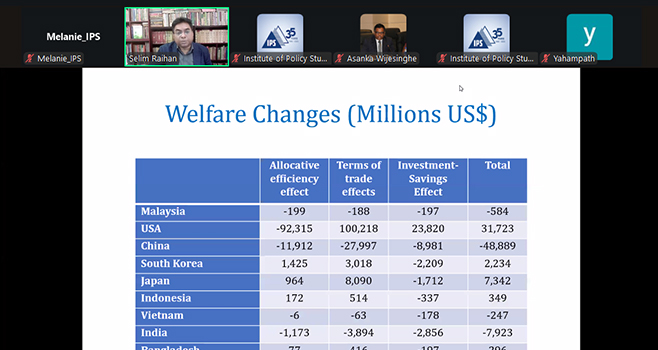
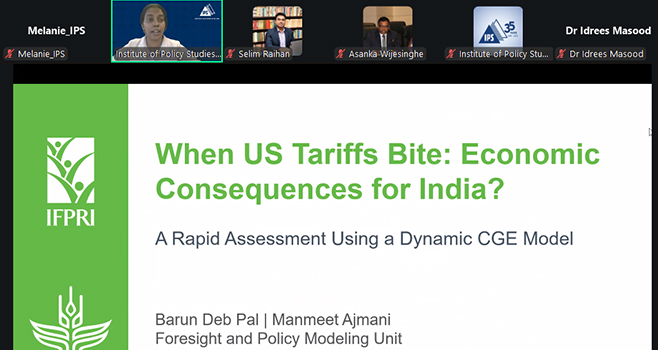
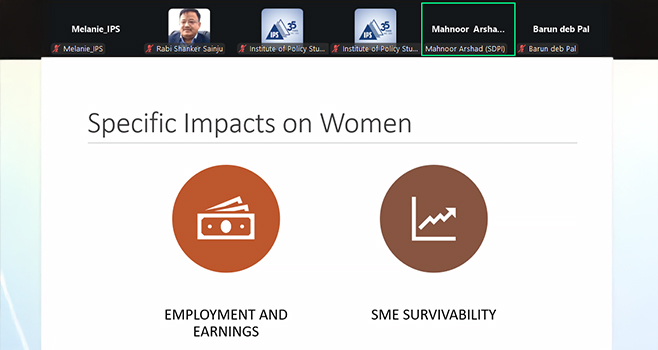
Economic experts from the region, Professor Selim Raihan of SANEM (Bangladesh) and Dr Barun Deb Pal of IFPRI (India) shared country-specific data on the impact that an increasing US tariff would have on the Gross Domestic Product (GDP), trade, sectoral outputs, labour force, and investments in their respective countries. Joining in as discussants, Ms Mahnoor Arshad (Pakistan) highlighted the gendered impacts of tariff shocks while Mr Rabhi Shankar Sainju (Nepal) observed constraints faced in absorbing the benefits of diverted trade.
The discussion concluded that the short-term effects of US tariffs on South Asia vary across countries. However, these effects pose a long-term challenge of eroding the region’s export-led growth model. The panellists agreed that regional cooperation, export diversification, and proactive trade negotiations are essential for South Asia to protect growth and employment amidst a shifting global trade order.